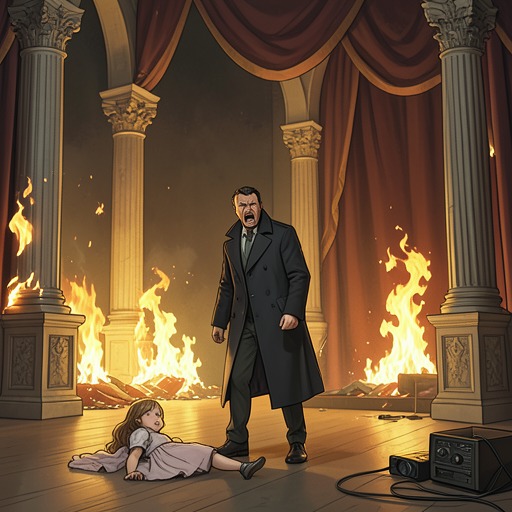
Execution of Claudia and Madeleine
Interview with the VampireExecution of Claudia and Madeleine is the Paris vampire coven’s punishment of Claudia and Madeleine after the coven captures Louis and condemns Claudia for her role in the attack on Lestat. The event destroys Louis’s remaining family, exposes the theatrical institution’s lethal authority, and turns his search for vampire knowledge into a catastrophe whose immediate answer is vengeance against the Théâtre des Vampires.
Causes and Judgment
The execution follows Louis’s encounter with the Théâtre des Vampires, a theater that makes vampiric killing appear as entertainment for a human audience. Its invitation-only performance presents Death through masks, music, painted scenery, and seven vampires surrounding a mortal woman; the crowd responds with gasps, laughter, sighs, and applause while the staged spectacle conceals an actual predation. The theater therefore establishes the coven’s central power: it controls not only bodies but also the frame through which violence is seen and interpreted.
Armand brings Louis and Claudia into this world by sending Louis a card inviting him to the theater and addressing him as the companion of the “petite beauty.” After the performance, Armand leads them beneath the theater into an underground ballroom covered with monumental scenes of death and damnation. The subterranean rooms function as both sanctuary and tribunal. Their elaborate art, restricted access, and concealed chambers create a separate social order in which the coven can observe, confine, and judge outsiders while maintaining a public facade for human spectators.
The judgment is connected to Claudia’s attack on Lestat. Santiago and the other vampires enter while Louis, Claudia, and Madeleine are resting in the rooms of the Hôtel Saint-Gabriel. Louis initially believes that he can protect the two women, pulling Claudia toward the door and fighting Santiago and Celeste. He is stronger than during his earlier encounter in the Latin Quarter, but the coven overwhelms him through numbers and persistence. Madeleine, still a fledgling, is terrified and unable to resist as the vampires surround her. Louis is forced out of the rooms, while the coven separates him from the women whose safety has become the purpose of his resistance.
Capture and Confinement
During the seizure, Lestat appears alive before the assembled vampires. Louis tries to use Lestat as a witness, urging him to explain how he treated Louis and Claudia and to acknowledge that they did not know the laws governing vampires. Lestat instead asks Louis to return to him and insists that Claudia must die, claiming that she was responsible for what happened to him. His plea reveals both his continuing attachment to Louis and his willingness to sacrifice Claudia to recover his former companion.
Lestat’s position is also compromised. Santiago reminds him that no promise has been made to restore Louis to him, and the coven treats him as a figure who can be manipulated rather than as an equal authority. Lestat’s desperation becomes part of the tribunal’s spectacle. He tries to bargain, promises to tell Louis something about the night in the swamp, and protests that Claudia attacked him, but the coven proceeds according to its own decision.
Louis is forced into a coffin with large iron locks while Madeleine’s exhausted cries continue nearby. He struggles against the lid, hears the metal locks being closed, and is carried away. The vampires bury the coffin in earth and seal it behind newly laid bricks. Inside, Louis attempts to reassure himself that Armand will return the following night and release them, yet the confinement turns hope into a form of torment. The repeated sensations of water, earth, mortar, boots, and the coffin’s narrow airspace make the coven’s authority physical: judgment is enacted by removing the condemned from sight and immobilizing the witness who might resist it.
The Execution
Armand eventually finds Louis and breaks through the brickwork, releasing him from the sealed coffin. He leads Louis through a passage lined with other sealed doors, suggesting a hidden architecture of imprisoned and starving vampires, and brings him back toward the rooms where the coven has gathered. Armand’s rescue does not prevent the sentence already carried out. His intervention arrives after the decisive loss and can only remove Louis from the scene.
Lestat is present, visibly weakened and afraid, with a small object concealed beneath his black cloak. When Louis seizes it, he discovers Claudia’s yellow dress. The dress is torn and stained with blood, and Lestat’s tears confirm that he knows what has happened even though he cannot or will not save her. The garment becomes the material proof of Claudia’s absence before Louis sees the bodies themselves. It also collapses the distinction between Lestat’s earlier theatrical manipulation and the coven’s real violence: the object he holds is not a prop but the remnant of a destroyed life.
Through an open doorway, Louis sees Madeleine and Claudia lying beneath the rain. Their remains repeat an earlier image from the Rue Royale, where a murdered mother and daughter had been found together. Here, however, the victims are the family Louis created and protected. Madeleine’s burned body still bears the impression of her living face, her hand remaining whole as it clutches Claudia; Claudia has been reduced to ashes, while her golden hair and the small blood-stained chemise remain visible among the remains. The contrast between Madeleine’s recognizable corpse and Claudia’s ash gives the execution two forms of erasure: one body is preserved as a ruin, while the child vampire is nearly annihilated.
The coven’s destruction is therefore not an instantaneous public performance like the theater’s staged killing. It is revealed through aftermath: a dress, rain, ash, hair, a ruined dress, and a tiny hand-mark against the bricks. The execution’s most devastating image is not the act of burning but Louis’s recognition of what remains after the fire. The site is a small graveyard within the theater’s domain, a space where the theatrical community’s polished masks give way to material evidence of punishment.
Louis’s Response and Revenge
Louis reacts with a cry that rises into physical violence. He attacks Santiago, pounding and twisting his face while Santiago struggles and cries out. Louis’s grief is inseparable from his attempt to recover the remains, yet Armand restrains him and forces him away from the small yard. Armand says that he could not prevent what happened, but his explanation does not absolve him in Louis’s experience: he has brought Louis into the theater’s orbit, failed to stop the sentence, and then removed him from the bodies before he could gather them up.
The execution leaves Louis in a condition of narrowed purpose. The coven’s laughter, once part of the theater’s seductive spectacle, becomes remote and meaningless beside the question of where Claudia is. Madeleine and Claudia cease to be participants in the theater’s society and become victims whose destruction demands a reply. The event also completes Louis’s disillusionment with the promise that Paris might provide origins, instruction, or communion with his own kind. The community he sought is revealed as a closed institution whose law is enforced through concealment, theatrical display, imprisonment, and death.
Louis’s revenge follows soon afterward. He obtains a small scythe, hires a carriage and driver, and waits near the Théâtre des Vampires until dawn, when the vampires are presumed to have entered their coffins. He nails pieces of wood across the bolted doors from outside, then carries barrels of kerosene into Armand’s underground rooms. Finding Armand’s cell empty, he pours kerosene over the exposed beams, wooden doors, horsehair chairs, draperies, corridors, and the theater’s velvet stage curtain. The execution thus reverses the theater’s spatial logic: the institution that had hidden killing beneath performance is itself marked for destruction while its members sleep in sealed chambers.
Narrative and Thematic Significance
The execution is the central reversal of Louis’s Parisian adventure. He had entered the theater expecting revelations and had been drawn into a world where death was choreographed as spectacle. The coven instead converts his curiosity into culpability, captures his family, and destroys the person whose childlike body embodied both his love and his moral failure. The event joins the theater’s public performance to its private punishment: onstage, vampires pretend to kill a mortal woman before delighted spectators; backstage, they kill Claudia and Madeleine beyond the protection of the human gaze.
The event also clarifies the contrast between Louis and the coven. Louis remains divided by feeling, responsibility, and attachment, even when he kills. The coven treats death as an institutionally managed act, placing masks on faces, arranging bodies, commanding movement, and laughing at terror. Its order depends upon turning victims into roles and witnesses into an audience. Louis’s resistance begins when he refuses that arrangement, first by fighting to protect Madeleine and Claudia, then by refusing to let their remains become merely another scene within the theater.
The loss reshapes the meaning of Louis’s relationship with Claudia. He had understood her as a companion whose violence and intelligence were bound to him, but the execution exposes the fragility of a family built within vampiric power structures. Her yellow dress, the bloodstains, the ash, and the hair mingled with Madeleine’s make her absence tangible. Later, when Louis recounts the story to the boy, the boy responds not with acceptance but with a demand for the same immortal power that produced this catastrophe. Louis insists that the ending could not have been otherwise, while the boy sees passion and adventure where Louis sees despair. The execution therefore becomes both the proof of vampiric damnation and the story’s most dangerous advertisement for it: the tragedy that destroys Louis is also what makes immortality appear irresistible to a mortal listener.